


Knowing how to price WordPress projects is the decision that shapes everything else in your business. Get it right, and you build a sustainable operation with healthy margins. Get it wrong, and you end up working harder every year for roughly the same income — or worse, less.
Yet most WordPress professionals set their prices based on gut feeling, whatever their last competitor quoted, or what they think the client can afford. That is not a strategy to price WordPress projects. That is guessing.
This article breaks down the four main pricing models agencies use to price WordPress projects today, examines what recent industry data reveals about profitability thresholds, and provides a practical framework you can apply to your next proposal.
What 622 Agencies Say About How to Price WordPress Projects
The Admin Bar’s 2026 State of the WordPress Agency survey gathered responses from 622 agency owners and freelancers across 51 countries. The data reveals patterns that should make every WordPress professional reconsider their pricing approach.
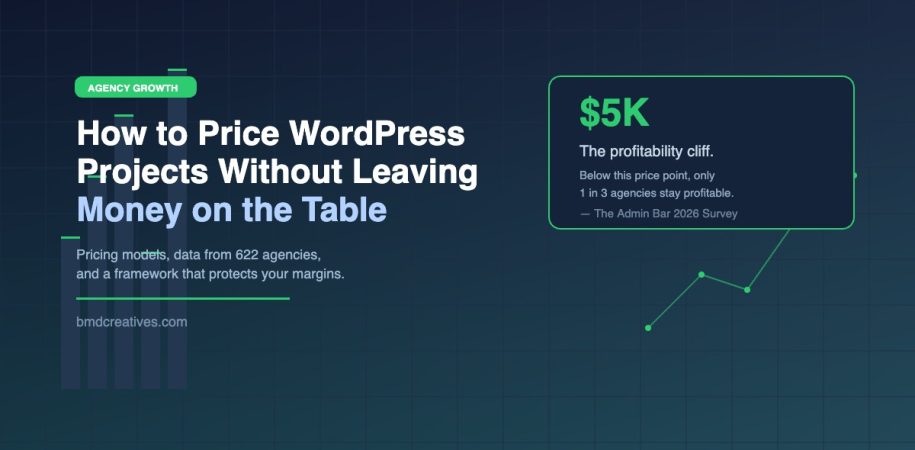
The most striking finding is what we can call the $5,000 profitability cliff. Among agencies charging under $1,000 per project, only 25% reported being consistently profitable, while 37.5% said they were rarely or never profitable. That ratio flips dramatically once project prices cross the $5,000 mark: 56.8% of agencies at that tier reported consistent profitability, and only 2.7% were rarely profitable.
The implication is clear. If you are pricing most of your WordPress projects below $5,000, the math is working against you. This does not mean every project must exceed that number, but your average should sit comfortably above it if you want a business — not just a job.
Recurring Revenue: The Key When You Price WordPress Projects
The survey also showed that recurring revenue is the clearest dividing line between struggling and thriving agencies. Of agencies with zero recurring revenue, nearly 60% were unprofitable. But once recurring revenue reached just 25% of total income, unprofitability dropped below 10% — and stayed there regardless of how much higher that percentage climbed.
This means that even a modest care plan or maintenance retainer offering can fundamentally change your financial trajectory. You do not need recurring revenue to dominate your income; you need enough of it to cover your baseline costs so that project work becomes pure growth.
The Four Pricing Models and When Each Works
Every WordPress agency operates within one of four pricing frameworks, or some hybrid of them. None is universally superior. The right model depends on your client mix, operational maturity, and risk tolerance.
1. Hourly Rate
You charge for time spent and invoice based on logged hours. Rates for WordPress developers in 2026 range from $25/hour at the entry level to well over $200/hour for senior agency professionals in premium markets.
When it works: Overflow tasks, consulting, discovery phases, and projects where scope genuinely cannot be defined upfront. It is also useful early in a client relationship when you do not yet have enough context to estimate fixed costs accurately.
The problem: Hourly pricing penalizes efficiency. The faster and better you get at your craft, the less you earn for the same deliverable. It also shifts the client’s attention from outcomes to time, creating a relationship where every email and every revision feels like the meter is running. According to the Admin Bar data, hourly-priced agencies had the lowest growth rate in 2025 at 42.2% and the second-lowest consistent profitability at 39.8%.
2. Fixed Price (Project-Based)
You define the scope, set a price, and deliver. The client knows exactly what they are paying, and your margin improves proportionally with your efficiency.
When it works: One-time builds, redesigns, migrations, and any project where you can clearly define the deliverables and timeline. This is the most common model for WordPress website projects.
The problem: Scope creep. Without a strong change-order process, clients will add requests that erode your margin one “small tweak” at a time. Estimation risk is also real — underestimate the complexity and the project becomes unprofitable. Fixed-price agencies sat at 36.4% consistent profitability and 47.4% growth in the survey data.
3. Retainer
The client pays a fixed monthly fee for a defined block of services, hours, or deliverables. You get predictable revenue; they get priority access to your team.
When it works: Ongoing maintenance, iterative development, content updates, and any situation where work is continuous rather than project-based. Retainers are the foundation of scalable agency economics.
The data speaks for itself: Retainer-based agencies in the 2026 survey reported the highest consistent profitability (51.2%), the highest percentage reaching $100K+ revenue (59%), and the strongest growth in 2025 (56.6%). The survey notes that stronger agencies tend to gravitate toward retainers, so the model reflects a healthy business as much as it creates one. But the correlation is undeniable.
The risk: Unused hours that expire at month end. A retainer with 40% utilization is burning margin. Discipline in capacity planning is essential.
4. Value-Based
You price based on the business value your work delivers, not on the cost or time required to produce it. If a WooCommerce build will generate $200,000/year in new revenue for the client, your fee reflects a portion of that outcome rather than a count of development hours.
When it works: When you can quantify the impact of your work and the client is sophisticated enough to think in ROI terms. This model requires strong communication, case studies proving your results, and the confidence to anchor your price to outcomes.
The problem: Not everything is easily quantifiable. A branding refresh or a content migration has real value, but attributing specific revenue numbers to it is difficult. Value-based pricing showed 46.2% consistent profitability in the survey — respectable, but notably, only 27.3% of value-based agencies reached $100K+ revenue, the lowest of all models. This suggests that while the margins can be excellent, volume may suffer if every deal requires extensive ROI justification.
A Practical Framework to Price WordPress Projects
Theory is useful. A system you can actually apply is better. Here is a framework that works whether you are a solo freelancer or a mid-sized agency.
Step 1: Know Your Floor Before You Price WordPress Projects
Calculate your fully-loaded cost per hour. This is not just your desired salary divided by working hours. It includes taxes, insurance, software licenses, hosting costs, non-billable time (admin, marketing, sales), and a profit margin. If your target annual income is $100,000 and you estimate 1,500 billable hours per year, your floor rate is approximately $67/hour — before adding any margin. Most professionals who do this math properly discover their actual floor is 30-50% higher than the rate they have been charging.
Step 2: Estimate Scope in Hours, but Quote a Fixed Price
Use your experience to estimate the real hours a project will require. Include discovery, development, QA, revisions, client communication, and deployment. Then multiply by your rate and add a 15-25% buffer for unknowns. Present this to the client as a fixed project fee. This gives them budget certainty and gives you margin protection if you deliver efficiently.
Step 3: Define Scope in Writing — Every Time
A Statement of Work (SOW) is non-negotiable. It should specify what is included, what is excluded, how many revision rounds are covered, and what the process is for out-of-scope requests. The SOW is not bureaucracy; it is the document that protects your profitability. Every scope-creep disaster started with a vague scope definition.
Step 4: Build Recurring Revenue Into Every Engagement
Every project handoff is an opportunity to propose a maintenance plan. WordPress sites need updates, security monitoring, backups, and performance checks. Package these into a monthly care plan at $150-$500/month depending on the complexity of the site. This is not upselling — it is responsible service delivery. A client whose site gets hacked three months after launch because nobody was monitoring it will blame you, not their own negligence.
Step 5: Reassess Quarterly
Review your pricing every three months. Track actual hours against estimates on completed projects. Calculate your effective hourly rate (total project revenue divided by total hours spent, including all communication and revisions). If that number is below your floor, you have a pricing problem — not a productivity problem.
Five Mistakes When You Price WordPress Projects
Competing on price. If your primary differentiator is being cheaper than the next agency, you are in a race you cannot win. There will always be someone willing to charge less. Compete on expertise, reliability, communication quality, and results instead.
Quoting before scoping. Never provide a price before you understand the project. A “quick estimate” based on a vague brief is a commitment you will regret. If a prospect wants a number before a proper conversation, that is a signal about how the entire engagement will go.
Ignoring non-billable time. For every hour of development, you likely spend 15-30 minutes on emails, project management, and context-switching. If you price projects based only on development hours, you are subsidizing your client’s project management for free.
Discounting to win the deal. Discounts train clients to expect discounts. If you reduce your price to close a deal, you have established your value at the lower number. The original quote becomes irrelevant. Instead, if a client’s budget is genuinely lower, reduce the scope to match — never the rate.
Not raising prices annually. Your costs increase every year. Your skills improve. Your tools get better. Your processes get tighter. If your rates stay flat, your real income is declining. The best time to raise prices is at the start of a new year or when onboarding a new client. Existing clients should receive notice of annual adjustments as a standard business practice.
What the Market Looks Like in 2026
The WordPress development market in 2026 reflects a maturing industry. According to WPNearMe’s 2026 rate data, US developer rates now sit between $75 and $200+/hour at the agency level, with agencies charging 30-100% more than equivalent freelancers due to the project management, QA, and accountability layer they provide.
AI proficiency is emerging as a pricing differentiator. Developers who effectively integrate AI tools into their workflow are commanding up to 25% higher rates because they deliver faster without sacrificing quality. The efficiency gain does not reduce prices — it increases the value of the developer’s time.
The offshore pricing gap is narrowing. Over half of companies reported that offshore developer rates remained stable in 2025, while nearly 28% saw increases, particularly for senior talent in Eastern Europe. The cost advantage of offshore development is still real, but it is not as dramatic as it was five years ago, and the hidden costs of timezone gaps, communication overhead, and revision cycles often close the gap further.
The Bottom Line
Learning to price WordPress projects is not a one-time exercise. It is a strategic decision that you refine continuously based on your costs, your market, your efficiency, and the value you deliver.
The data is clear: agencies that charge above $5,000 per project, maintain at least 25% recurring revenue, and operate on retainer or productized models are dramatically more likely to be profitable, growing, and sustainable.
If the way you price WordPress projects does not reflect the full cost and value of what you deliver, this is the week to change that. Not next quarter. Not when the “right client” comes along. Now.
Need a WordPress development partner who understands agency economics? Let’s talk.

